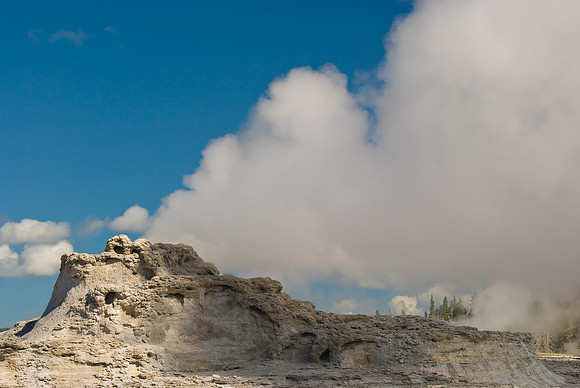
July 28, 2009; Upper Geyser Basin;Yellowstone National Park.
[Downloadable for Desktop Wallpaper; Personal Use Only!] From Wikipedia:A
geyser (
US /??a?z?r/;
UK /??i?z
?/[1]) is a
spring characterized by intermittent discharge of water ejected turbulently and accompanied by a
vapour phase (steam). The word
geyser comes from
Geysir, the name of an erupting spring at
Haukadalur,
Iceland; that name, in turn, comes from the
Icelandic verb
geysa, "to gush", the verb itself from
Old Norse.
The formation of geysers is due to particular
hydrogeological conditions, which exist in only a few places on Earth, so they are a fairly rare phenomenon. Generally all geyser field sites are located near active
volcanic areas, and the geyser effect is due to the proximity of
magma. Generally, surface water works its way down to an average depth of around 2,000 metres (6,600 ft) where it contacts hot rocks. The resultant boiling of the pressurized water results in the geyser effect of hot water and steam spraying out of the geyser's surface vent (a
hydrothermal explosion).
About a thousand known geysers exist worldwide, roughly half of which are in
Yellowstone National Park,
Wyoming,
United States. A geyser's eruptive activity may change or cease due to ongoing
mineral deposition within the geyser plumbing, exchange of functions with nearby
hot springs,
earthquake influences, and human intervention.
[2]Jet-like eruptions, often referred to as
geysers, have been observed on several of the
moons of the outer solar system. Due to the low ambient pressures, these eruptions consist of vapor without liquid; they are made more easily visible by particles of dust and ice carried aloft by the gas. Water vapor jets have been observed near the south pole of
Saturn's moon
Enceladus, while
nitrogen eruptions have been observed on
Neptune's moon
Triton. There are also signs of
carbon dioxide eruptions from the southern polar ice cap of
Mars. In the latter two cases, instead of being driven by geothermal energy, the eruptions seem to rely on solar heating via a solid-state
greenhouse effect.