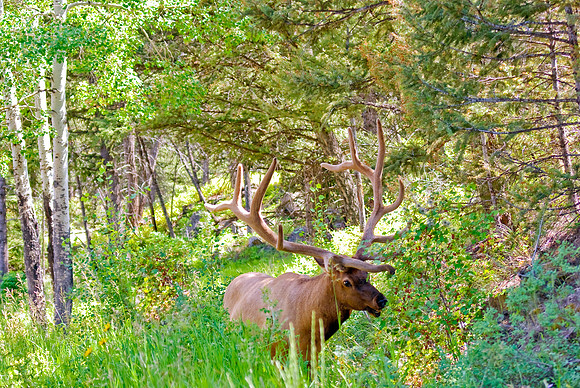
July 26, 2009; Undine Falls;Yellowstone National Park.
From Wikipedia:The
elk or
wapiti (
Cervus canadensis) is one of the largest species of
deer in the world, and one of the largest land
mammals in
North America and
eastern Asia. It was long believed to be a
subspecies of the European
red deer (
Cervus elaphus), but evidence from a 2004 study of the
mitochondrial DNA indicates that the two are distinct
species.
This animal should not be confused with the larger
moose (
Alces alces), to which the name "elk" applies in Eurasia. Apart from the moose, the only other member of the deer family to rival the elk in size is the south Asian
sambar (
Rusa unicolor).
Elk range in forest and forest-edge habitat, feeding on grasses, plants, leaves, and bark. Although native to North America and eastern Asia, they have adapted well to countries where they have been introduced, including
Argentina,
Australia, and
New Zealand. Their great adaptability may threaten
endemic species and ecosystems into which they have been introduced.
Male elk have large
antlers which are shed each year. Males also engage in ritualized mating behaviors during the
rut, including posturing, antler wrestling (sparring), and
bugling, a loud series of vocalizations which establishes dominance over other males and attracts females.
Elk are susceptible to a number of
infectious diseases, some of which can be transmitted to livestock. Efforts to eliminate infectious diseases from elk populations, largely through vaccination, have had mixed success.
Some cultures revere the elk as a spiritual force. In parts of Asia, antlers and their
velvet are used in
traditional medicines. Elk are hunted as a game species; the meat is leaner and higher in
protein than
beef or
chicken.
[2]