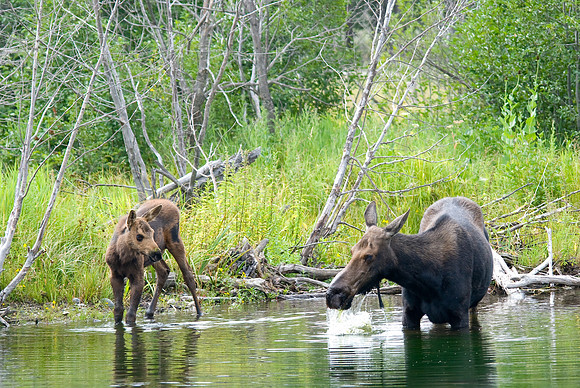
August 5, 2009; Moose Road; Grand Teton National Park.
From Wikipedia:The
moose (North America) or
Eurasian elk (Europe) (
Alces alces) is the largest
extant species in the
deer family. Moose are distinguished by the
palmate antlers of the males; other members of the family have antlers with a
dendritic ("twig-like") configuration. Moose typically inhabit
boreal and
mixed deciduous forests of the
Northern Hemisphere in
temperate to
subarctic climates. Moose used to have a much wider range but hunting and other human activities greatly reduced it over the years. Moose have been re-introduced to some of their former habitats. Their diet consists of both terrestrial and aquatic vegetation. The most common moose predators are
wolves,
bears, and
humans. Unlike most other deer species, moose are
solitary animals and do not form herds. Although generally slow-moving and sedentary, moose can become aggressive and move surprisingly fast if angered or startled. Their mating season in the autumn can lead to spectacular fights between males competing for the right to mate with a particular female.
The animal bearing the scientific name
Alces alces is known in Britain as the "elk",
[2] and in
North America as the "moose".
The
British English word
"elk" has cognates in other
Indo-European languages, for example
elg in
Danish/
Norwegian,
?lg in
Swedish,
Elch in
German and
?o? in
Polish. Confusingly, the word
elk is used in North America to refer to a different animal, the
elk or less commonly
wapiti (
Cervus canadensis), which is similar though slightly smaller (the North American species is the second largest
deer species) and behaviorally and genetically divergent from the smaller
red deer of central and western Europe. Presumably early European explorers in North America called it
elk because of its size and presumably because, as men coming from the British Isles they would have had no opportunity to see the difference between a member of the genus
Cervus and an animal fitting the description of
Alces at home, where the latter was nowhere present in the 17th and 18th century.
The word
moose first entered English by 1606,
[3] and is a borrowing from
Algonquian languages (compare
Narragansett moos and
Eastern Abenaki mos, according to early sources likely derived from
moosu meaning "he strips off"),
[4] possibly involving forms from multiple languages mutually reinforcing one another. The
Proto-Algonquian form was
*mo?swa.
[5]A mature male moose is referred to as a bull, a mature female moose is a cow, and an immature moose of either sex is a calf.