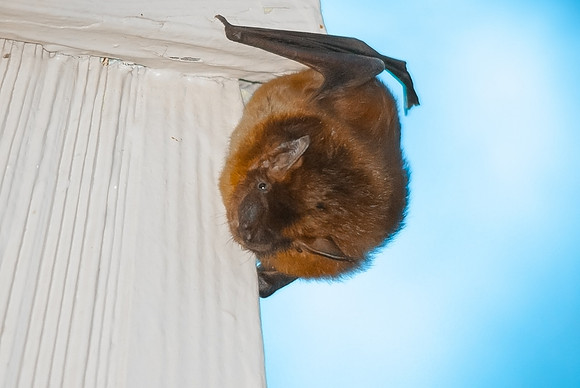
July 18, 2012; West Yellowstone, Yellowstone National Park.
From Wikipedia:Bats are
mammals of the order
Chiroptera (
/ka??r?pt?r?/; from the
Greek ???? -
cheir, "hand"
[2] and ?????? -
pteron, "wing"
[3]) whose forelimbs form webbed
wings, making them the only mammals naturally capable of true and sustained
flight. By contrast, other mammals said to
fly, such as
flying squirrels, gliding possums, and
colugos, glide rather than fly, and can only glide for short distances. Bats do not flap their entire forelimbs, as
birds do, but instead flap their spread-out
digits,
[4] which are very long and covered with a thin
membrane or
patagium.
Bats represent about 20% of all classified mammal species worldwide, with about 1,240 bat species divided into two suborders: the less specialized and largely fruit-eating 'megachiroptera', or flying foxes, and the more highly specialized and echolocating 'microchiroptera'.
[5] About 70% of bats are
insectivores. Most of the rest are
frugivores, or fruit eaters. A few species, such as the fish-eating bat, feed from animals other than insects, with the
vampire bats being the only parasitic mammalian species. Bats are present throughout most of the world, performing vital ecological roles of
pollinating flowers and dispersing fruit seeds. Many tropical plant species depend entirely on bats for the distribution of their seeds. Bats are important in eating insect pests, reducing the need for pesticides. The smallest bat is the Kitti's hog-nosed bat, measuring 29?34 mm (1.14?1.34 in) in length, 15 cm (5.91 in) across the wings and 2?2.6 g (0.07?0.09 oz) in mass.
[6][7] It is also arguably the smallest extant species of mammal, with the
Etruscan shrew being the other contender.
[8] The largest species of bat is the giant golden-crowned flying fox, which is 336?343 mm (13.23?13.50 in) long, has a wingspan of 1.6 m (5 ft 3 in) and weighs approximately 1.1?1.2 kg (2?3 lb).
[9]