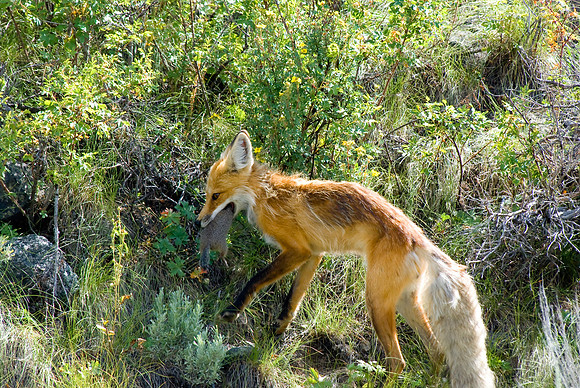
July 30, 2009; Lamar Valley;Yellowstone National Park.
From Wikipedia:The
red fox (
Vulpes vulpes) is the largest of the
true foxes and the most geographically spread member of the
Carnivora, being distributed across the entire
Northern Hemisphere from the
Arctic Circle to
North Africa,
Central America and
Asia. Its range has increased alongside human expansion, having been introduced to
Australia, where it is considered harmful to native mammal and bird populations. Because of these factors, it is listed as
Least Concern for extinction by the
IUCN.
[1] It is included among the IUCN's list of the
"world's 100 worst invasive species".
[2]The red fox originated from smaller-sized ancestors from
Eurasia during the
Middle Villafranchian period,
[3] and colonised
North America shortly after the
Wisconsian glaciation.
[4] Among the true foxes, the red fox represents a more progressive form in the direction of
carnivory.
[5] Apart from its large size, the red fox is distinguished from other fox species by its ability to adapt quickly to new environments and, unlike most of its related species, is not listed as
endangered anywhere. Despite its name, the species often produces individuals with abnormal colourings, including
albinos and
melanists.
[6] Forty-five
subspecies are currently recognised,
[7] which are divided into two categories: the large northern foxes, and the small, primitive southern foxes of Asia and the Middle East.
[8]Red foxes are social animals, whose groups are led by a
mated pair which monopolises breeding. Subordinates within a group are typically the young of the mated pair, which remain with their parents to assist in caring for new kits.
[9] The species primarily feeds on small rodents, though it may also target
leporids,
game birds,
reptiles,
invertebrates[10] and young
ungulates.
[11] Fruit and vegetable matter is also eaten on occasion.
[12] Although the red fox tends to displace or even kill smaller predators, it is nonetheless vulnerable to attack from larger predators, such as
wolves,
coyotes,
golden jackals and medium- and large-sized
felines.
[13]The species has a long history of association with humans, having been extensively hunted as a pest and furbearer for centuries, as well as being prominently represented in human folklore and mythology. Because of its widespread distribution and large population, the red fox is one of the most important furbearing animals harvested for the
fur trade.
[14]